The ‘winner takes all’ pricing games


From the epoetin market situation came the idea to develop a pricing game. An early version was developed and used within J&J. In 2011 a new version of the game was developed that allowed adaptation of the variables of the game so that it could be used for many more situations. This version has been played over 50 times by key account managers, tender experts and market access professionals from 11 different corporations.
The participants are split into competitive teams that are bidding for the business of six hospitals. The market changed overnight into a mandatory ‘winner takes all’ market, where each hospital is tendering for full volume. The hospitals differ in volume needs, incumbent player(s) at the start of the game and price sensitivity. Participants know or can estimate these characteristics from the short descriptions of the hospitals. The game is pre-programmed on award conditions, threshold to switch (if any), and growth rates by customer. Each product has a set attractiveness to the customers, an element which cannot be influenced in the game. As the game continues, teams split into new teams, e.g. to role play a new entry of a branded or generic competitor, and more and more competitors are offering for the same set of customers. There are three to six rounds of bidding, and after each round the teams immediately receive the results of their bids to prepare for the next round. Awarding is pre-programmed, hence not dependent of the way the participants behave in the game.
The pricing game is most telling when it is played several times under the same conditions, by different players. Figure 1 shows the real results of two typical outcomes of the game: in the red game we see significant slower price erosion than in the blue game. However, simulated market conditions were similar and purchasing decision making was pre-programmed to be identical. This illustrates a key point of price competition: while the authorities or individual customers set the conditions to allow price competition, it is the competitive behaviour of the teams that will define the intensity of price erosion. Participants regularly comment after the game that the simulation is very illustrative for the real environment. So, we may conclude that for a market with low differentiation between the products and for ‘winner takes all’ conditions, competitive behaviour is a key driving factor for price erosion.
The game has been played by participants from Asia, Middle East, Western Europe and Eastern Europe, including Russia. Although there was adequate participation from each geography, we could not observe differences in pricing behaviour. We could however recognise the impact of corporate culture, with clear barriers to strong and fast discounting in some companies and a drive to market share in others. However, in all games the end net prices after six rounds of tendering in a market with low differentiation, two incumbents, one new entry, and one biosimilar were 75-88% lower than the starting prices, just above the cost of goods of the cheapest producer (set at 10% of starting price).
FIGURE 1
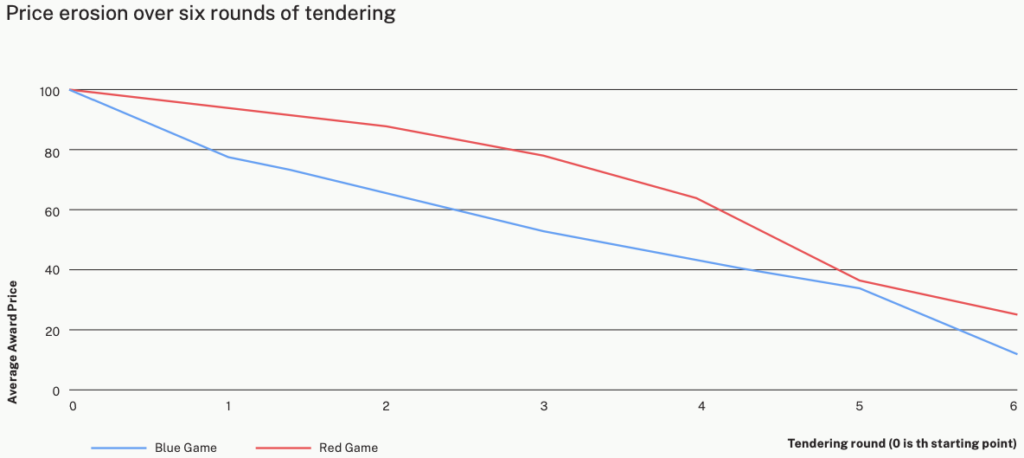
Typical results from the pricing game
Although the results of the pricing game look dramatic, they are very close to what is happening in the real world. Indeed, hospital tendering was named as the main cause to reduce epoetin and filgrastim prices with reductions of up to 89% in Norway for both filgrastim and epoetin alfa, whereas discounts for use outside the hospitals were 50% for filgrastim and only 25% for epoetin alfa.22 Filgrastim reached more than 90% discounts in some French hospital tenders, whereas retail prices were only 10-15% below list price.23
So, in this simulated tendering ‘winner takes all’ environment, we found substantial price erosion, leading to very low net prices after just few rounds of tendering. The speed of price erosion is function of the number of competitors, aggressivity of the players, and the lowest cost of goods in the game.