- European Commission: European Health and Digital Executive Agency, Vogler, S., Salcher-Konrad, M., & Habimana, K., “Study on best practices in the public procurement of medicines: final report,” Publications Office of the European Union, 2022.
- Statistics | Eurostat, [Online]. Available: https://ec.europa.eu/ eurostat/databrowser/view/hlth_sha11_hf__custom_12775622/ default/table?lang=en. [Accessed 12 September 2024].
- “Texts adopted – Shortage of medicines – how to address an emerging problem – Thursday, 17 September 2020,” © European Union, 2020 – Source: European Parliament, [Online]. Available: https://www.europarl.europa.eu/doceo/document/TA-9-2020-0228_EN.html. [Accessed 12 September 2024].
- S. Kinkartz, “German Health Ministry confronts drug shortage,” dw.com, 18 February 2023. [Online]. Available: https://www. dw.com/en/health-ministry-confronts-germanys-dire-medicineshortage/a-64733080. [Accessed 16 September 2024].
- A. G. Vulto, J. Vanderpuye-Orgle, M. Van Der Graaff, S. R. A. Simoens, L. Dagna, R. Macaulay, B. Majeed, J. Lemay, J. Hippenmeyer and S. Gonzalez-McQuire, “Sustainability of Biosimilars in Europe: A Delphi Panel Consensus with Systematic Literature Review,” Pharmaceuticals, vol. 13, no. 11, p. 400, 17 November 2020.
- J. Karliner, S. Slotterback, R. Boyd, B. Ashby, K. Steele and J. Wang, “Health care’s climate footprint: the health sector contribution and opportunities for action,” European Journal of Public Health, vol. 30, no. Issue Supplement_5, September 2020.
- L. Belkhir and A. Elmeligi, “Carbon footprint of the global pharmaceutical industry and relative impact of its major players,” Journal of Cleaner Production, vol. 214, pp. 185-194, March 2019.
- The Paris Agreement | UNFCCC, [Online]. Available: https://unfccc.int/process-and-meetings/the-parisagreement. [Accessed 12 September 2024].
- Goal 3: Good health and well-being | United Nations Development Programme, UNDP, [Online]. Available: https://www.undp.org/sustainable-development-goals/ good-health. [Accessed 12 September 2024].
- Corporate Standard | GHG Protocol, 1 February 2013. [Online]. Available: https://ghgprotocol.org/corporatestandard. [Accessed 12 September 2024].
- A patient-centric EU Green Deal: Building sustainable, equitable and resilient healthcare systems – MedTech Europe, MedTech Europe, 22 May 2024. [Online]. Available: https:// www.medtecheurope.org/resource-library/a-patient-centriceu-green-deal-building-sustainable-equitable-and-resilienthealthcare-systems/. [Accessed 12 September 2024].
- The European Green Deal: New Opportunities for Sustainable Healthcare, Health Care Without Harm, 29 June 2020. [Online]. Available: https://europe.noharm. org/news/european-green-deal-new-opportunitiessustainable-healthcare. [Accessed 12 September 2024].
- Directive (EU) 2024/1760 of the European Parliament and of the Council of 13 June 2024 on corporate sustainability due diligence and amending Directive (EU) 2019/1937 and Regulation (EU) 2023/2859, European Parliament, Council of the European Union, 13 June 2024. [Online]. Available: https://eur-lex.europa. eu/eli/dir/2024/1760/oj. [Accessed 12 September 2024].
- Circular Economy Action Plan, European Commission, [Online]. Available: https://environment.ec.europa.eu/strategy/circulareconomy-action-plan_en. [Accessed 12 September 2024].
- White Paper on Circular Economy, EFPIA, [Online]. Available: https://www.efpia.eu/media/htreo44j/white-paper-oncircular-economy.pdf. [Accessed 12 September 2024].
- M. Capobianco, A. Qureshi, P. Martin, F. Torelli and F. Cousins, “HPR195 Assessing the Adoption of Sustainability Criteria Within National Healthcare Procurement Policies in Europe” Value in Health, vol. 25, no. 12, p. S268, December 2022.
- NHS Net Zero Supplier Roadmap, NHS England, November 2023. [Online]. Available: https://www.england.nhs.uk/ greenernhs/wp-content/uploads/sites/51/2024/04/NHS-NetZero-Supplier-Roadmap-2024.pdf. [Accessed 12 09 2024].
- Germany’s ESG Law: A case study for new pharma pricing model, Pharmaceutical Technology, 19 July 2021. [Online]. Available: https://www.pharmaceutical-technology. com/pricing-and-market-access/germanys-esglaw-a-case-study-for-new-pharma-pricing-model. html/?cf-view. [Accessed 12 September 2024].
- AMGROS announces tendering procedure with new environmental Criteria, AMGROS, 10 June 2024. [Online]. Available: https://www.amgros.dk/about-amgros/news/ amgros-announces-tendering-procedure-with-newenvironmental-criteria/. [Accessed 12 September 2024].
- More sustainability in the health and care sector, Sustainable healthcare | Government.nl, 23 February 2024. [Online]. Available: https://www.government.n// topics/sustainable-healthcare/more-sustainability-inthe-care-sector. [Accessed 12 September 2024].
Content Type: Child
As the pharmaceutical industry faces increasing pressure to integrate sustainability into their operations, the importance of alignment with international and national environmental guidelines becomes pivotal to gain a competitive edge in healthcare tenders.
Having visibility on tender award criteria per product and country is critical to be able to differentiate versus competitors and pro-actively discuss how to optimize tender settings and frameworks to improve attractiveness and sustainability of the market.
Furthermore, developing sustainable practice plans that support compliance and company goals, whilst ensuring they meet tender awarding criteria will enhance market position and differentiate products amongst competitors.
About the Authors
Ines Oliveira
Consultant
Stephen Hall
Director
Valid Insight is a specialist global market access consultancy, offering expert support across multiple disciplines. We have assisted pharma and biotech companies in developing sustainable practice plans that support compliance and company goals, leveraging our tendering expertise across global markets. We support our clients to ensure they optimise strategic frameworks and operations to meet tender awarding criteria and enhance their market position, while contributing to global environment goals.
To find out more about how Valid Insight can support you in optimising tender strategy, please reach out to discover@bioscriptgroup.com
Maria Samoili
Marketing Executive
Nico Bacharidis
Chief Commercial Officer
Cube RM is the leading global Tender Software, AI & Data company, empowering Life Sciences organizations to find more business opportunities and build market intelligence. Our platforms use the latest AI & NLP technology to capture key tender market data globally and transform it into actionable market intelligence, coupled with seamless software automation & industry expertise to increase tender processes efficiency.
For further information on how Cube RM can support you in terms of tender data, technology & insights please reach out to info@cuberm.com
Although many European countries, such as Finland and Poland, still lack environmental sustainability criteria in their tendering processes, and others like Estonia, Lithuania, Portugal, Slovakia, and Slovenia continue to rely solely on price as the main criteria for awarding tenders, numerous governments are beginning to prioritize environmental requirements in their healthcare tendering processes. 1
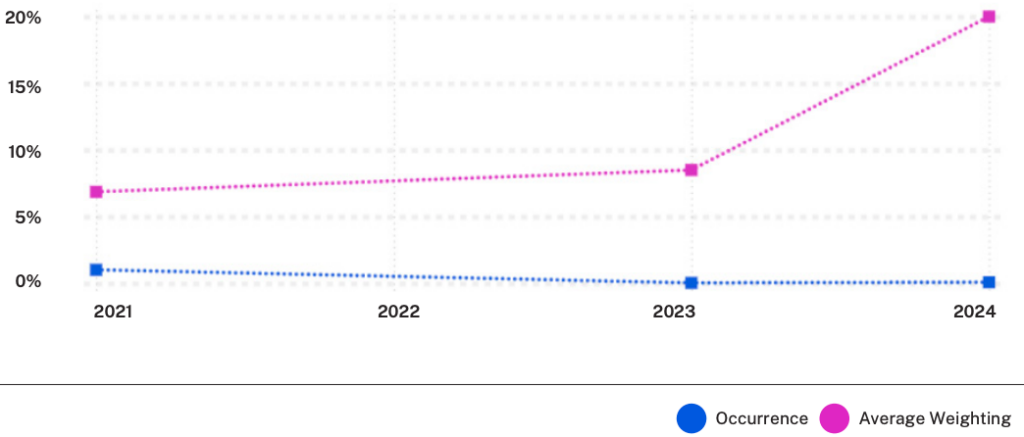
The analysis performed by Cube RM also reveals this trend.
FIGURE 11
Year on year trend of % occurrence and average weighting of Social-Environmental sustainability in criteria used in awarded batches of top biosimilars' tenders since 2021
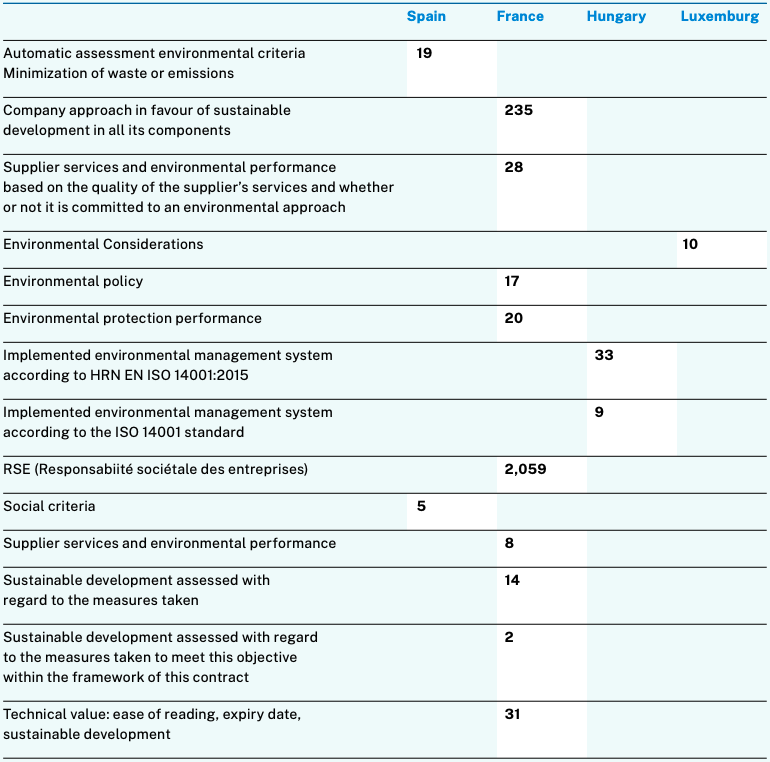
FIGURE 12
Examples of environmental tender criteria used in awarded lots (of all pharmaceuticals)
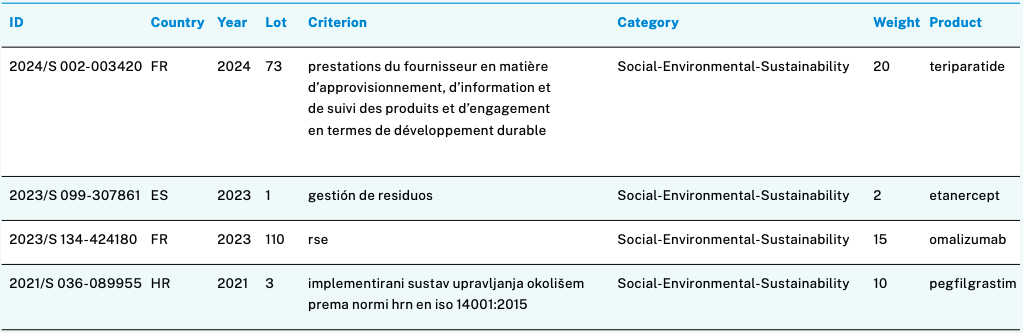
FIGURE 13
Examples of environmental tender criteria used in awarded lots (of biosimilars) and weight attributed
One clear example of the influence of environmental sustainability in tendering is the Net Zero Supplier Roadmap from NHS England, that started in 2022 with the requirement that all NHS procurements needed to include a minimum 10% net zero and social value weighting.
The plan, extending beyond 2030, establishes that suppliers will only be able to qualify for NHS contracts if they can demonstrate their progress through published progress reports and continued carbon emissions reporting. 17
Such other examples are replicated throughout Europe:
- In Germany, the government has implemented guidelines emphasizing the use of eco-friendly products and services 18
- In Belgium, environmental criteria such as waste reduction and water recycling have been applied when awarding bids 1
- In Denmark, Croatia, Norway, and Spain, centralised PPM at national level includes environmental criteria 1, 19
- In the Netherlands, the Dutch government’s criteria for sustainable healthcare procurement focuses on reducing the carbon emissions and promoting circular economy practices 20
- And in Ireland, suppliers are benefited when they provide medicines in recyclable packaging 1
As a result, one of the main challenges pharmaceutical companies face is balancing the increasingly important environmental sustainability practices with the need to remain competitive, especially when price is still the primary criterion for awarding contracts.
Incorporating environmental sustainability into companies’ processes can be a significant undertaking. It requires a comprehensive approach, including changes in manufacturing, supply chain management, and product design. Many of these changes are heavily regulated and resource-intensive, often taking a considerable amount of time to be approved and implemented. However, in the long term, there are numerous benefits that can encourage pharmaceutical companies to go green:
- While implementing sustainable practices may involve initial costs, it can lead to long-term savings. Companies that invest in green technologies, energy efficiency, and waste reduction can reduce operational costs, making their bids more competitive.
- Demonstrating a commitment to environmental sustainability enhances a company’s reputation and builds trust with stakeholders, including healthcare providers, patients, and regulators. This positive perception can influence tender decisions in favour of companies perceived as responsible and forward-thinking.
The importance of environmental sustainability in the pharmaceutical industry cannot be overstated. As the industry continues to grow, its environmental footprint also expands, contributing to pollution and resource depletion.
From the raw material extraction, to manufacturing processes, global distribution, and eventual disposal6, the pharmaceutical industry is responsible for generating approximately 52 megatons of CO27 annually – an amount exceeding the emissions of the automotive sector in nations like the UK.
As concerns about climate change, ecosystem protection, and human health continue to rise, numerous frameworks have highlighted the numerous frameworks have highlighted the need to address the environmental impact of the healthcare sector, including the Paris Agreement8, the UN’s Sustainable Development Goals (SDG)9, and the Greenhouse Gas Protocol10.
B The Corporate Sustainability Due Diligence Directive (CSDDD) applies to large EU limited liability companies and partnerships, encompassing approximately 6,000 companies with more than 1,000 employees and a net turnover exceeding EUR 450 million worldwide. For large nonEU companies, around 900 entities with a net turnover of more than EUR 450 million within the EU are included. The Directive includes provisions to facilitate compliance and limit the burden on companies, both in scope and within the value chain. Micro companies and SMEs are not directly covered by the proposed rules, but the Directive provides supporting and protective measures for SMEs that might be indirectly affected as business partners in value chains.
In the EU, the European Commission has been actively developing plans and roadmaps to establish environmental sustainability criteria in healthcare tenders. Some key initiatives and frameworks include:
- The European Green Deal, introduced in 2019, aims to transform the EU into a sustainable, climate-neutral economy by 2050. The Green Deal emphasizes the importance of creating sustainable healthcare systems that not only protect human health but also the environment. This include promoting the use of safer chemicals, reducing pharmaceutical pollution, and ensuring sustainable procurement practices.11, 12
- The Corporate Sustainability Due Diligence Directive (CSDDD) mandates that companies identify, mitigate, and transparently report on environmental impacts throughout their operations and value chains. To comply with the CSDDDB, companies will need to invest in sustainability initiatives such as adopting green technologies, improving energy efficiency, and ensuring sustainable procurement practices. This directive encourages collaboration between companies, governments, and other stakeholders to develop innovative and responsible solutions to address their environmental impact.13
- The Circular Economy Action plan, which aims to promote sustainable resource use and reduce waste, encourages pharma companies to adopt eco-design principles such as creating products that are easier to recycle, designing products for longer use, and using secondary raw materials. 14,15
- Across Europe, several countries have also started developing their own sustainability initiatives, focusing on the impact of procurement/tendering and health technology assessments, and how to contribute to the United Nation’s Sustainable Development Goals.
FIGURE 10
European countries with sustainability initiatives Adapted from HPR195 Assessing the Adoption of Sustainability Criteria Within National Healthcare Procurement Policies in Europe
When analysing the main criteria in MEAT tenders, a combination of factors beyond price are used to evaluate tenders.
FIGURE 8
Annual cumulative % of occurrence and average weighting of criteria used in awarded batches of top biosimilars' tenders since 2021
When analysing the data for the average weighting of the criteria used in awarded lots (Fig. 9), terms and conditions have now become the most recurrent criteria used, right after price.
Due to the supply and logistics issues caused by the Covid-19 pandemic plus some major stock-outs, also for Biosimilars, the importance of logistics, delivery, and supply in healthcare tendering has significantly increased5. Avoiding shortages of essential medicines and maintaining availability of supply to ensure treatment of critical populations continues to be paramount to patients’ health and to keep hospitals working smoothly.
Some other criteria, however, have seen a decline in importance. Packaging, quality, product technical features, and safety have all had a slight decrease in relevance as awarding criteria. Not surprisingly, social and environmental sustainability has shown a relative growth in importance since 2021.
FIGURE 9
Year on year trend of % average weighting of different criteria used in awarded batches of top biosimilars' tenders since 2021
Cube RM’s analysis of 16,845 awarded batches of top biosimilars across all European countries since 2021, conducted using proprietary and tender-specific, AI-based search algorithms that crawl multiple online tender sources worldwide, provides further evidence of these trends.
The data visualized within the Cube RM platform shows that price continues to be the most important criteria when awarding tenders. However, some evolution towards tender sustainability can be observed. For instance, when examining the use of price-only versus MEAT criteria by country cluster, some interesting patterns emerge.
Annual MEAT vs Price-Only Top Biosimilars' Tenders in European Countries since 2021 Aggregated by Cluster
Countries were divided in clusters based on market strategy, i.e. which markets are prioritized in a company’s launching strategy. Cluster 1: Germany, France, Italy, Spain, and UK; Cluster 2: Denmark, Finland, Iceland, Norway, and Sweden; Cluster3: Czechia, Belgium, Ireland, Poland, and Portugal; Cluster 4: Bulgaria, Croatia, Cyprus, Estonia, Hungary, Latvia, Lithuania, Luxembourg, Malta, Romania, Slovenia, and Slovakia.
Cluster 1
In Germany, France, the UK, Italy, and Spain, MEAT criteria are becoming increasingly important in tendering processes.
Cluster 2
In Denmark, Finland, Iceland, Norway, and Sweden, MEAT represents now the main tendering practice.
Cluster 3
In Czechia, Belgium, Ireland, Poland, and Portugal, some tenders are starting to follow MEAT criteria, however price-only tenders continue to be the norm.
Cluster 4
In Bulgaria, Croatia, Cyprus, Estonia, Hungary, Latvia, Lithuania, Luxembourg, Malta, Romania, Slovenia, and Slovakia, price-only tenders also continue to represent the majority of cases.
In Focus
Germany for many years, was a typical ‘price-only’ country, driven by big national insurance tenders. However, due to recent supply challenges and shortages, we can observe an inclusion of supply-criteria in tenders in 2024.
Annual MEAT vs Price-Only Top Biosimilars' Tenders in Germany since 2021
Examples of extracted award criteria for supply in Germany
For public authorities and purchasers in the healthcare sector, the increasing availability of generic and biosimilar alternatives has made tendering an effective way to lower prices and increase patient access to treatments, while keeping healthcare expenditure under control. For companies, tendering can break monopolies by fostering open competition and equal opportunities, while also increasing transparency through public announcements and clear selection criteria.
However, traditional tendering practices with “winner takes all” and “price-only” scenarios often result in negative outcomes:
- In France, for example, a “winner takes all” approach led to product withdrawals from the market. Over time, some medicine classes had only one alternative available, causing shortages when supply quotas couldn’t be met.
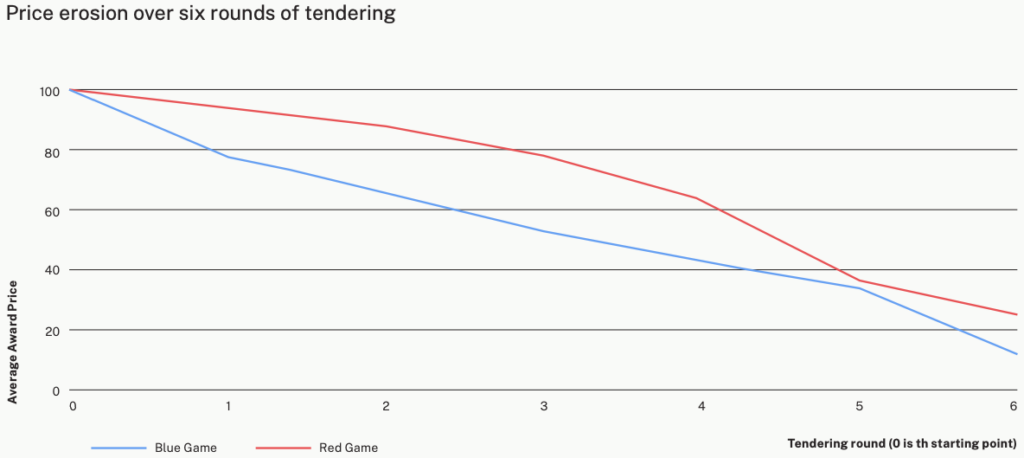
- When “price-only” criteria are used, pharmaceutical companies tend to resort to aggressive price-cutting behaviours driven by market share and sales priorities, further perpetuating price erosion in the pharmaceutical tendering market. The significant profit loss associated with the resulting price erosion can make commercialization unattractive, reducing supplier numbers and potentially increasing prices and shortages in the long term, effectively re-establishing a monopolization of the market.
In recent years, efforts to transform tendering into a more sustainable practice have led to various actions. These include reducing administrative burdens through pre-qualifications and electronic bidding systems, splitting contracts to minimize shortages, and awarding contracts based on criteria beyond price, such as supply and logistics, and environmental sustainability.
The European Commission conducted an online survey involving various stakeholders, such as national authorities for medicine pricing and reimbursement, public procurers, payers, pharmacists, patient representatives, and representatives from the pharmaceutical industry and wholesalers. The survey explored how specific PPM practices and procedures affect different policy goals.
Among the 58 participants, MEAT (Most Economically Advantageous Tender practices were ranked as the most important for achieving affordability, competition, and supply security. Stakeholders also highlighted that, similar to ensuring supply security, procurers might need to balance different policy objectives. Specifically, incorporating environmental criteria in procurement could lead to higher prices and/or reduced competition.
Average importance of PPM award criteria by policy objective Adapted from the European Commission Study on Best Practices in the Public Procurement of Medicines: Final Report
Ideally, depending on local policies and ambitions, different award criteria and tender practices should be given priority, reflecting a more balanced and holistic approach to procurement.
- https://www.who.int/health-topics/healthtechnology-assessment#tab=tab_1
- https://www.abpi.org.uk/partnerships/workingwith-patient-organisations/workingwith patientsand-patientorganisations -2022-sourcebook-forindustry/definitionsof-participants/#:~:text=The%20European%20Patients’%20Academy%20on, of%20living%20with%20a%20disease
About the author
Stephen Hall
Director
Stephen joined Valid Insight in 2019 and currently holds the position of Associate Director.
Before this, Stephen earned a PhD in Neuropharmacology, worked as a postdoctoral researcher in Neuroscience, and then joined the Wellcome Trust as a researcher. Here, his research focused on unraveling the disease pathologies of various neurological conditions. He has won several awards for his research, presented at prestigious conferences and published in high-impact journals. More recently, Stephen worked at the NHIR, writing documentation for health technology submissions to NICE and working closely with the topic selection group to communicate the complex details of health technology assessments. Stephen’s multifaceted background and accomplishments in academia, research, and healthcare make him a valuable asset to Valid Insight.
To find out more about how Valid Insight can support you in optimising tender strategy, please reach out to discover@bioscriptgroup.com
2025 presents the EU with an impending transformation — the implementation of the JCA process across all 27 member states. This harmonisation offers a remarkable opportunity to integrate patients and patient organisations into the JCA framework, not just as participants but as active collaborators in healthcare decision-making.
To leverage this opportunity to optimise patient engagement effectively, three key areas call for strategic consideration:
- Empowering patients through education and resources:
- Comprehensive training programs: Develop tailored educational initiatives to demystify the HTA process for patients.
- Interactive workshops: Organise hands-on sessions to equip patients with the skills to contribute effectively.
- Forging early collaborations with patients in product development:
- Uncovering real-world needs: Involve patients at the earliest stages of product development to gain invaluable insights into their experiences and steer innovation accordingly.
- Shaping value propositions: Align product profiles with patient preferences to address unmet patient needs and create compelling value propositions.
- Ensuring transparency, impact and clarifying the role of patient voices:
- Establishing funding mechanisms: Offer compensation for patient contributions to foster equitable involvement and mitigate financial barriers.
- Communicating clearly: Articulate how patient input will be utilised and its influence on outcomes to build trust and ensure meaningful participation.
- Implementing feedback loops: Create channels for patients to voice their perspectives on the process and its efficacy to drive continuous improvement.
By addressing these strategic considerations, healthcare stakeholders can foster meaningful patient involvement in HTAs, leading to more patient-centric healthcare decisions, improved outcomes, and a healthcare system that truly reflects the needs and values of the patients it serves.
As the EU moves towards the standardisation of the JCA process, it is crucial to ensure that patients and patient organisations are actively involved as co-architects of healthcare decision-making. Valid Insight stands ready to be your partner in navigating market access and patient engagement within the HTA and JCA processes.
Despite the widespread recognition of the importance of patient involvement in HTA, there is a lack of consensus on how to assess the quality of patient involvement.
Observing guidelines provides a systematic approach to assessing the quality of patient involvement in HTAs based on the following principles:
- Transparency: The process of patient involvement should be transparent, with clear and accessible information about how patients are involved, what their role is, and how their input is used.
- Accountability: Patients and patient organisations should assume responsibility for their involvement in HTAs, and mechanisms should be established to ensure accountability.
- Inclusiveness: Efforts must be made to ensure that individuals from diverse backgrounds and with different experiences are involved.
- Impact: Patient involvement should have a meaningful impact on the HTA process and the resulting decisions. This can be assessed by examining factors such as the degree of patient input reflected in the HTA report and the influence of patient involvement on the decision-making process.
- Capacity building: Organisations representing patients and patient advocates should have the capacity to participate effectively in HTAs. This includes having the necessary skills, knowledge, and resources.
- Sustainability: The involvement of patients in these processes should be sustainable, with mechanisms in place to ensure that they continue over time.
Ensuring high-quality patient engagement requires adhering to specific criteria and skills, where a transparent and meritbased selection process is crucial to identifying suitable patient advocates. Patient organisations often face resource constraints, emphasising the need for accessible training and support. Collaborative efforts can help bridge the resource gap and empower patient advocates to participate effectively in the JCA framework.