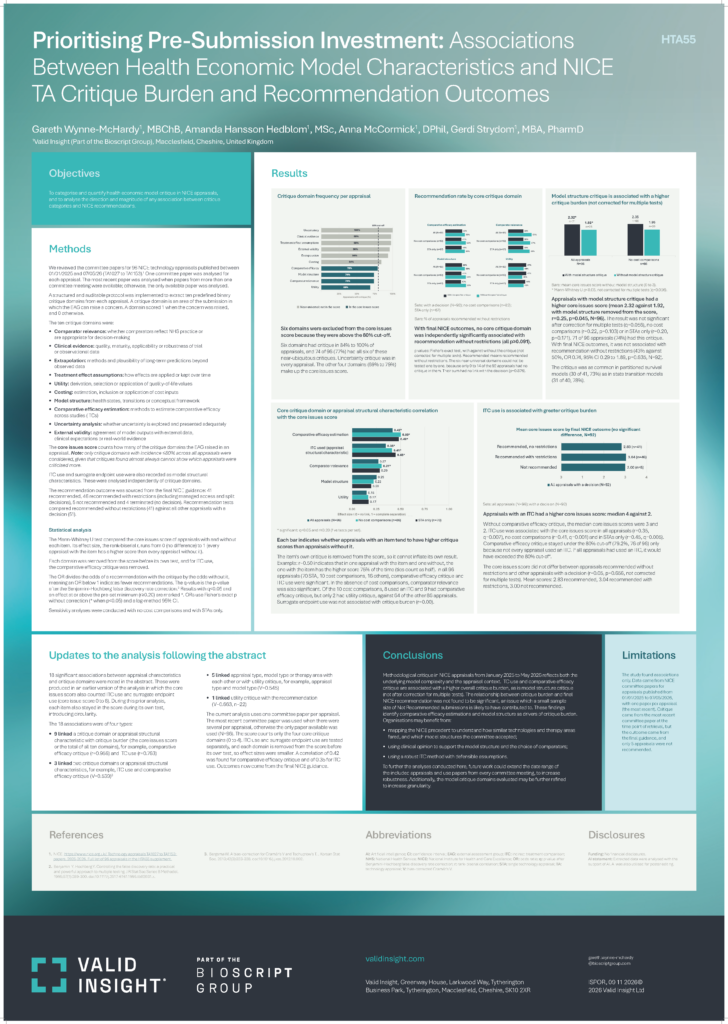

NICE technology appraisals routinely raise methodological concerns about submitted clinical evidence and economic models. For manufacturers preparing an HTA submission, understanding which criticisms are widespread and which are associated with greater overall critique burden can help inform pre-submission evidence planning.
Valid Insight reviewed committee papers for 96 NICE technology appraisals published between 1 January 2025 and 7 May 2026. Using a structured protocol, the study recorded ten predefined critique domains and examined their associations with appraisal characteristics and final NICE recommendation outcomes.
Key findings
1. Six critique domains were almost universal
Six of the ten domains appeared in 84% to 100% of appraisals, with uncertainty critique raised in every case. Because these concerns offered limited differentiation between appraisals, they were excluded from a four-domain core issues score.
This distinction is important when evaluating the extent of methodological scrutiny: the presence of commonly raised concerns does not necessarily indicate an unusually problematic submission.
2. Indirect treatment comparisons were associated with greater critique burden
Appraisals using indirect treatment comparisons (ITCs) had higher core issues scores than those without them. The association remained statistically significant after adjustment for multiple testing, including in sensitivity analyses excluding cost comparisons and restricted to single technology appraisals.
Comparative efficacy critique was also associated with greater overall critique burden. Model structure critique showed a similar association in the unadjusted analysis, but this did not remain statistically significant after correction for multiple testing.
These findings highlight comparative efficacy estimation and model structure as areas warranting careful pre-submission scrutiny.
3. Critique burden was not significantly associated with NICE recommendation outcomes
Among the 92 appraisals with a final decision, the overall core issues score did not differ significantly between unrestricted recommendations and other outcomes. No individual core critique domain was independently significantly associated with an unrestricted recommendation.
The findings, therefore, do not support using the number of documented methodological critiques as a predictor of the final NICE recommendation.
Implications for HTA and market access
For pharmaceutical manufacturers, the research supports a focused approach to pre-submission preparation: reviewing NICE precedents for comparable technologies, obtaining clinical input on model structure and comparator selection, and ensuring ITC methods and assumptions are robust and defensible.
The analysis identifies associations rather than causal relationships. It was limited to one committee paper per appraisal and included only five appraisals that were not recommended, constraining the assessment of recommendation outcomes.
The findings provide a basis for prioritising methodological review, but do not establish that addressing particular critiques will improve reimbursement outcomes.
Download the full research poster
Publication details
Poster title: Prioritising Pre-Submission Investment: Associations Between Health Economic Model Characteristics and NICE TA Critique Burden and Recommendation Outcomes
Authors: Gareth Wynne-McHardy, Amanda Hansson Hedblom, Anna McCormick and Gerdi Strydom
Conference: ISPOR Europe 2026, Vienna, Austria
Poster number: HTA55
Presentation: Monday, 9 November 2026, Poster Session 1 (10:30–13:30 CET); author discussion 12:30–13:30 CET