
NICE’s approach to health economic modelling is evolving. In selected disease areas, the traditional reliance on bespoke, company-developed models is giving way to more standardised frameworks, with implications for how manufacturers prepare and defend their HTA submissions.
At ISPOR Europe 2026, Valid Insight presented research examining this transition, the changing role of manufacturers in model development, and the opportunities and limitations of generative artificial intelligence (GenAI).
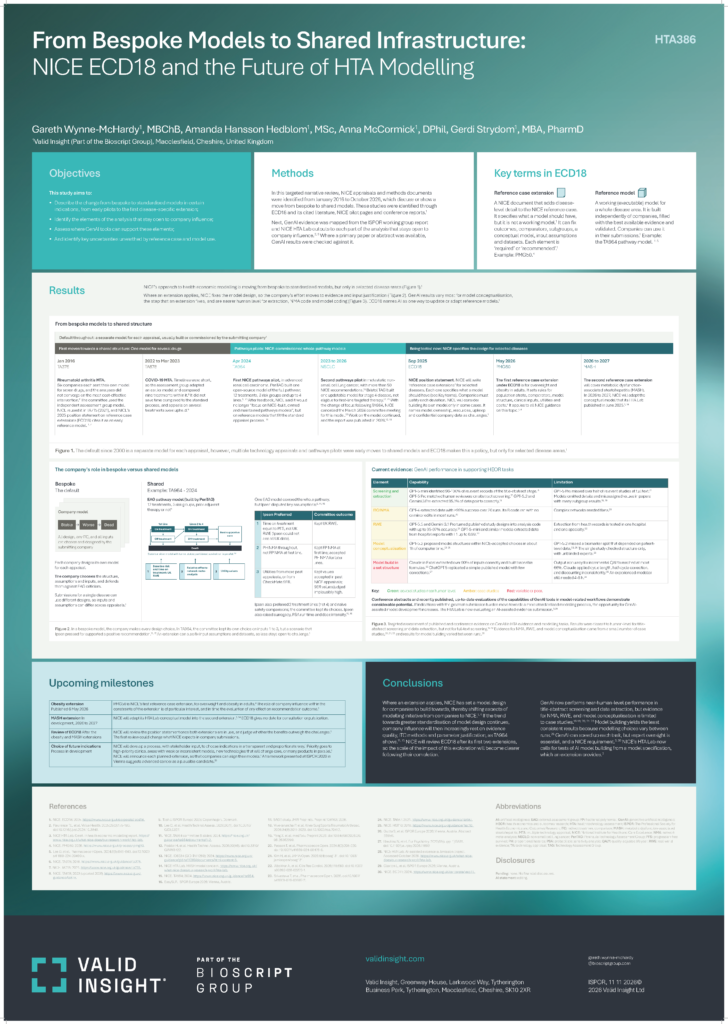
Our poster, From Bespoke Models to Shared Infrastructure: NICE ECD18 and the Future of HTA Modelling (HTA386), presents a targeted narrative review of NICE appraisals and methodological developments from 2016 to October 2026, alongside emerging evidence on GenAI in health economics and outcomes research (HEOR).
Key findings
1. NICE is moving towards more standardised economic models
NICE’s ECD18 position statement introduces disease-specific reference case extensions that establish modelling requirements for selected indications. Its first extension, published in May 2026, covers overweight and obesity in adults, with metabolic dysfunction-associated steatohepatitis (MASH) planned to follow.
This represents a shift towards greater consistency in model design, although bespoke modelling remains the default outside the selected disease areas.
2. The focus of manufacturer input is changing
Where reference case extensions apply, manufacturers have less discretion over aspects of model structure and design. The emphasis increasingly shifts towards the quality of clinical evidence, robust indirect treatment comparisons (ITCs), and the justification of model inputs and assumptions.
The review highlights the importance of understanding which elements are prescribed by NICE and where manufacturers can still influence the assessment.
3. GenAI offers opportunities, but expert oversight remains essential
The research also examines published evidence on GenAI across evidence screening, data extraction, network meta-analysis, real-world evidence, and economic model development.
While some studies report performance approaching that of human reviewers for screening and extraction, evidence for more complex modelling tasks remains limited. Model development is particularly challenging, with inconsistent outputs and continuing requirements for expert validation.
Implications for HTA preparation
For manufacturers, NICE ECD18 may change where pre-submission effort delivers the greatest value.
Understanding the applicable modelling framework early, identifying which assumptions remain open to challenge, and investing in robust evidence generation will become increasingly important where standardised approaches apply.
GenAI may help improve efficiency in selected activities, but methodological judgement and quality assurance remain central to credible HTA submissions.
Download the full research poster to explore the evolution of NICE modeling approaches, the changing role of manufacturers and the evidence on GenAI capabilities across HEOR activities.
Publication details
Poster: HTA386
Conference: ISPOR Europe 2026, Vienna, Austria
Presentation date: 11 November 2026
Authors: Gareth Wynne-McHardy, Amanda Hansson Hedblom, Anna McCormick, and Gerdi Strydom
Organisation: Valid Insight, part of the Bioscript Group